What to Consider Before Renting Drive-Up Storage in Niagara Falls, Ontario: 2026 Renter's Guide
Planning to rent drive-up self storage in Niagara Falls? Evaluate 30ft truck lane clearance, raised concrete flood barriers, lockbox shroud security, 24/7 access, and hidden admin fees before signing.
The 60-Second Drive-Up Renter’s Checklist
Before handing over your credit card or signing a storage rental contract in the Niagara Peninsula, verify these 5 operational non-negotiables:
Renting drive-up self storage in Niagara Falls should be one of the simplest logistical decisions you make during a residential move, home renovation, or business expansion. The fundamental premise of drive-up storage is unmatched convenience: you pull your pickup truck, cargo van, or 26-foot moving truck directly in front of your personal roll-up door, roll it open, and unload heavy furniture, appliances, or trade equipment in minutes.
However, not all drive-up storage facilities in Southern Ontario are engineered to the same operational standard. In the Niagara Region—where winter blizzards, driving lake-effect rain, spring snowmelt, and intense summer humidity test commercial structures—overlooking critical facility details can turn an affordable storage solution into a frustrating, costly headache.
According to operational criteria outlined by the Canadian Self Storage Association (CSSA), selecting a secure, resilient outdoor facility requires looking past promotional headline pricing. Here is everything you must evaluate before signing a storage agreement in Niagara Falls, Ontario.
How wide do facility driving aisles need to be for 26-foot moving trucks and dual-axle trailers?
One of the most common surprises first-time renters experience occurs on moving day: they arrive at their storage facility in a rented 20-foot or 26-foot moving truck, only to find the driving aisles are cramped, single-lane corridors measuring barely 18 to 20 feet across.
When a commercial moving truck parks to unload in a narrow 18-foot lane, it completely obstructs the entire row. If another tenant arrives in a pickup truck or family SUV, neither vehicle can pass, sparking stressful vehicular gridlock, damaged side mirrors, or forced reparking while holding heavy dressers.
The 30-Foot Driving Lane Benchmark
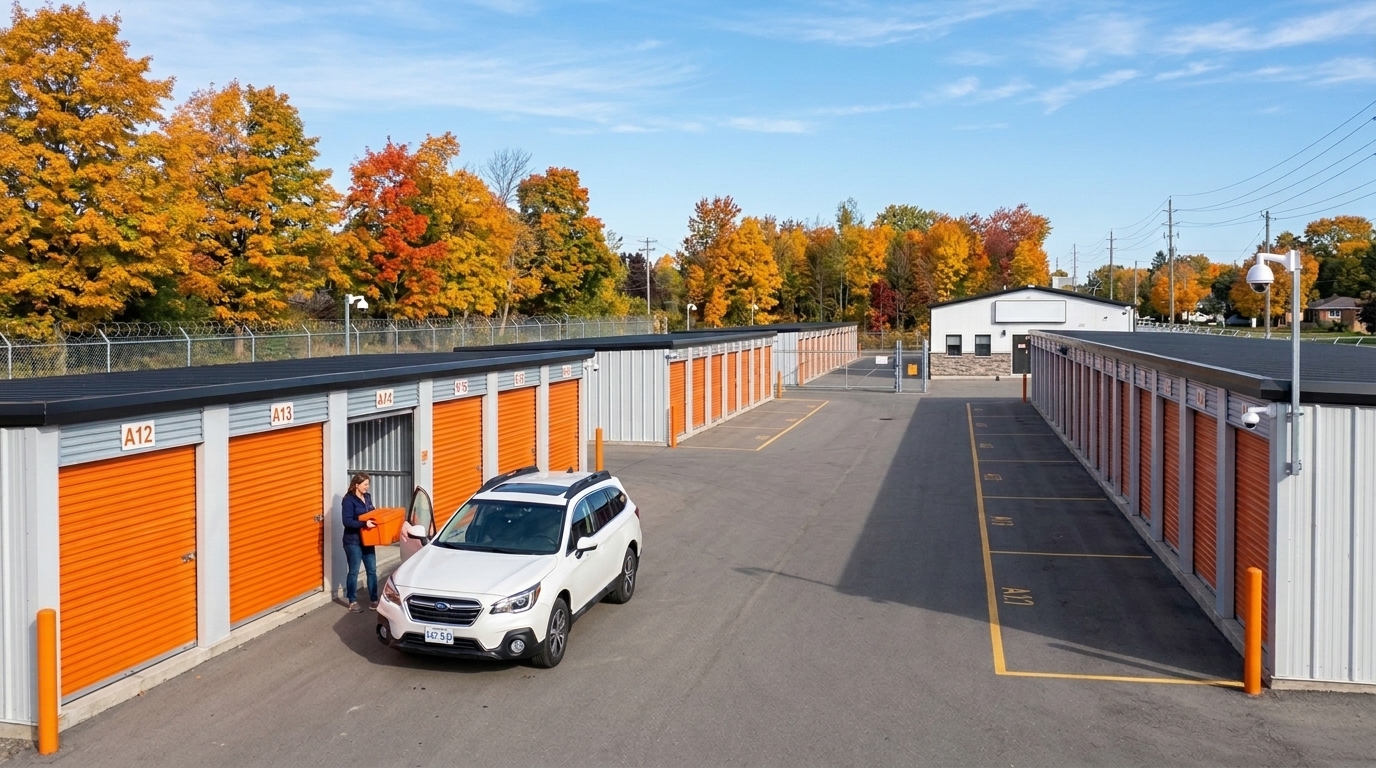
Under municipal commercial design practices across Niagara and Ontario building standards, professional logistics sites require wide turning radials. At HJ Storage (5584 Ramsey Road, Niagara Falls), our drive aisles are engineered at a generous 30 feet of width.
A 30-foot aisle provides sufficient clearance for dual-axle landscape trailers, enclosed cargo haulers, 26-foot commercial U-Haul trucks, and emergency vehicles to manoeuvre, back up perpendicular to roll-up doors, and pass one another without delay.
Why are raised concrete foundation thresholds essential for Niagara’s winter snow and rain runoff?
The Niagara Peninsula experiences intense weather swings: severe lake-effect snow squalls from Lake Erie, rapid mid-winter thaws with rain, and torrential springtime cloudbursts. When massive snowdrifts melt rapidly along asphalt driveways, ground-level structures face immediate water infiltration risks if not properly engineered.
Poorly constructed facilities build unit floors flush with the exterior asphalt driveway. When snow accumulates against the roll-up door or torrential rain overwhelms shallow driveway gutters, standing water can seep under the door gasket, soaking bottom-layer cardboard boxes, mattresses, and untreated timber.
Critical Weatherproofing Standards to Demand
- Raised Concrete Floor Pads: Interior unit slabs must be poured 2 to 4 inches higher than the surrounding driveway grade, creating a physical dam against ground moisture.
- Bevelled Threshold Lip (Weather Dam): A precision chamfer or bevel at the door interface forces rainwater down and away from the door curtain rather than allowing it to pool on the threshold.
- Heavy EPDM Vulcanized Rubber Sweeps: Flexible commercial-grade rubber door sweeps compress against the concrete pad to block windblown snow, driving sleet, dust, and insects.
- Engineered Grading & Catch Basins: The facility grounds must feature active storm runoff ditches and catch basins that whisk meltwater away from building foundations immediately.
When touring any outdoor storage facility in Niagara Falls, inspect the bottom edge of the roll-up doors. If the unit floor sits level with the gravel or pavement without a raised curb, your belongings are at risk during the first winter thaw.
What physical security hardware actually stops bolt cutters at a drive-up facility?
Security at an outdoor storage facility involves much more than just a chain-link fence. The vast majority of storage unit burglaries occur using manual 24-inch or 36-inch bolt cutters aimed directly at exposed padlock shackles.
If a facility allows tenants to fasten their roll-up doors with conventional, long-shackle hardware store brass padlocks, an opportunistic thief can sever the shackle in less than five seconds.
Exposed Padlocks & Weak Latches
Standard flat latches leaving the entire padlock shackle completely exposed. Anyone with a pair of contractor bolt cutters or an electric grinder can cut the lock without resistance.
Welded Steel Lockbox Shrouds
Heavy-gauge welded steel security housing that completely encases the disc lock. The shackle is 100% recessed, preventing bolt-cutter jaws from ever contacting or gripping the steel.
Beyond physical lock shrouds, comprehensive site security requires an integrated multi-tier defense system:
- Automated Electronic Security Gate: Every customer receives an individual, unique PIN code that logs exact date, time, and identity at every entry and exit.
- Full-Perimeter Security Fencing: Heavy-gauge industrial fencing surrounding the entire property perimeter with no blind spots or vegetation overgrowth.
- High-Definition CCTV Coverage: Commercial night-vision surveillance cameras focused directly down every drive aisle, recording continuous vehicle traffic.
- Active On-Site Staff Presence: Facilities with real managers conducting regular daily grounds audits deter suspicious activity far more effectively than remote, unmanned locker facilities.
How do gate access hours affect unpredictable moving schedules and contractor workflows?
One of the most overlooked clauses in self-storage rental agreements is the gate operating schedule. Many multi-storey indoor facilities and older storage yards restrict access strictly to staffed office hours—closing electronic gates as early as 5:00 PM or 7:00 PM on weekdays, and noon on Saturdays or Sundays.
In the real world, moving day rarely runs precisely on schedule:
- Real Estate Closing Delays: Escrow transactions, key exchanges, and lawyer deed registrations frequently don't finalize until 4:30 PM on Friday afternoon. By the time you load your furniture into a rental truck, an indoor facility with 6:00 PM closing locks you out—leaving your moving truck full overnight on a public street.
- Trades & Contractor Shifts: Niagara contractors, roofers, and landscapers need to pick up cement mixers, scaffolding, or generators at 6:00 AM before driving to a job site in St. Catharines or Welland, and return equipment after 6:30 PM.
- Weekend DIY Flexibility: Loading personal household goods after work in the summer evening hours requires access until 9:00 PM or later.
At HJ Storage, we provide 24/7/365 electronic keypad gate access. Your unique access code opens the security gate any hour of the day or night, every single day of the year, giving you complete logistical autonomy.
What hidden administration fees and move-in surcharges should you watch out for in storage contracts?
When searching for self-storage online, you will frequently see advertisements promoting headline rates like *"First Month $1"* or *"50% Off First 2 Months."*
Before getting lured by introductory discounts, read the fine print carefully. Large corporate storage chains routinely recoup promotional discounts through an array of mandatory move-in surcharges:
| Fee Category | Typical Corporate Storage Chain | HJ Storage Policy |
|---|---|---|
| Administrative Setup Fee | $25 to $50 mandatory fee at move-in | $0.00 (Never charged) |
| Security Deposit | $50 to 1 full month’s rent held in escrow | $0.00 (Zero deposit required) |
| Mandatory Lock Purchase | Forced purchase of proprietary lock ($25–$35) | Bring your own disc lock or buy on-site for $15 |
| Contract Commitment | 3-month, 6-month, or 12-month lock-in clauses | 100% Month-to-Month Flexibility |
| Rate Increase Notice | Automatic rate spikes after initial 60–90 days | Stable, transparent community pricing |
At HJ Storage, our monthly pricing is straightforward: 5×8 from $86/mo, 10×10 at $159/mo, 10×15 at $185/mo, and 10×20 at $210/mo (+HST). What you see is exactly what you pay on your monthly invoice.
How do you choose the right drive-up unit size to avoid overpaying for empty air?
Renting more storage space than you actually need is the single fastest way to overpay for self-storage. Conversely, renting a unit that is too small forces you to pack boxes to the ceiling without an aisle, making it impossible to retrieve individual items later.
Here is our quick rule of thumb based on local Niagara households:
5×8 Drive-Up Storage Unit
Ideal for dorm rooms, studio apartments, seasonal patio furniture, snow tires, motorcycles, or 35–45 standard storage totes.
10×10 Drive-Up Storage Unit
Fits the contents of a typical 1 to 2 bedroom Niagara apartment: sofa set, queen mattress set, refrigerator, washer/dryer, dining set, and dozens of boxes.
10×15 Drive-Up Storage Unit
Fits a 2 to 3 bedroom home or substantial contractor inventories: multiple bedroom sets, living room suites, exercise equipment, lawn tractors, or work tools.
10×20 Drive-Up Storage Unit
Equivalent to a standard single-car garage. Accommodates a full 3 to 4 bedroom home with major appliances, or can be used for car, pickup truck, or boat indoor vehicle storage.
What items belong in outdoor drive-up storage versus indoor climate lockers?
Storage marketing often asserts that every item in your home requires heated or air-conditioned climate control. While extreme climate control is essential for sensitive archival paper, unlacquered wood instruments (violins, cellos), and multi-thousand-dollar oil paintings, over 85% of standard household and commercial goods store safely and cleanly in drive-up units:
Ideal for Drive-Up Storage
- Major appliances (refrigerators, washers, ovens, dishwashers)
- Household furniture (tables, chairs, dressers, bed frames)
- Sofas and mattresses (when packed in breathable plastic or mattress covers)
- Lawnmowers, snowblowers, chainsaws, power tools
- Motorcycles, ATVs, classic cars, small boats, utility trailers
- Seasonal sports equipment (skis, golf clubs, kayaks, camping gear)
- Contractor building materials, scaffolding, tiles, and drywall
Better Suited for Indoor Climate Control
- Fine acoustic musical instruments (acoustic guitars, violins, pianos)
- Museum-grade oil paintings and delicate original artwork
- Antique unsealed paper documents, vintage stamp collections, rare comic books
- High-end vintage wine collections requiring 55°F humidity control
- Unlacquered solid wood heirloom antiques older than 100 years
By storing standard furniture, seasonal gear, and appliances in a clean, weather-sealed drive-up unit at HJ Storage, you save 25% to 40% every single month compared to paying indoor climate overhead.
Frequently asked questions
How wide should storage facility driveways be for moving trucks in Niagara Falls? ▾
Commercial storage drive aisles should measure at least 25 to 30 feet wide. A standard 26-foot U-Haul or Penske moving truck requires an 8.5-foot width and a wide turning radius. Narrow 18-foot alleyways create bottlenecks when another customer is unloading. At HJ Storage (5584 Ramsey Road), our 30-foot wide compacted driving aisles permit two heavy commercial vehicles to pass comfortably side-by-side or back right up to your roll-up door.
How do drive-up storage units prevent water and snowmelt from getting inside? ▾
Quality drive-up facilities engineer grade-level weatherproofing through raised concrete foundation slabs (at least 2 to 4 inches above the exterior driveway level), precision perimeter drainage sloping away from unit doors, and heavy-duty EPDM vulcanized rubber door sweeps. This ensures melting snow, torrential autumn rainstorms, and spring runoff flow away into storm retention drains rather than under your roll-up door.
What type of lock offers the highest theft protection for drive-up units? ▾
The most secure setup combines a welded steel lock shroud (a protective steel box built around the door latch) with a hardened stainless steel disc padlock or cylinder lock. The shroud physically encloses the padlock shackle, making it virtually impossible for bolt cutters, pry bars, or angle grinders to access the locking mechanism. Standard exposed brass padlocks should never be used on outdoor units.
Are there hidden fees when renting self storage in Niagara Falls? ▾
Many corporate storage chains advertise low teaser rates (e.g., '$1 for the first month') but attach mandatory $25 to $50 administrative setup fees, forced lock purchases ($20 to $30), security deposits, and mandatory in-house insurance policies. At HJ Storage, we believe in complete fee transparency: zero administrative setup fees, zero security deposits, and straightforward month-to-month contracts with no long-term lock-in.
Can I access my drive-up unit after business hours or on statutory holidays? ▾
At HJ Storage, tenants enjoy true 24/7/365 electronic keypad gate access. Whether you need to load trade tools at 5:30 AM before a construction shift or unload household furniture late Sunday evening after an unexpected closing delay, your unique security PIN grants full access to your unit 365 days a year without scheduling appointments.
How can you reserve your drive-up storage unit at 5584 Ramsey Road today?
Units start from just $86/mo with 30-foot drive aisles, raised flood-proof thresholds, tamper-proof lock shrouds, and 24/7 gate access. Zero administrative fees and zero security deposits.
Related Regional & Planning Guides
- Moving Stress Guide Why ground-level units eliminate elevator delays
- Outdoor vs. Indoor Guide Cost breakdown & Ontario weather performance
- Sizing & Packing Checklist Furniture inventory guides for 5×8 to 10×20
Prioritize HJ Storage in Google Search & AI Overviews
Add HJ Storage as a preferred source on Google to see our newest Niagara storage tips, seasonal deals, and unit availability first when you search.